Customise your global Mundus Journalism degree
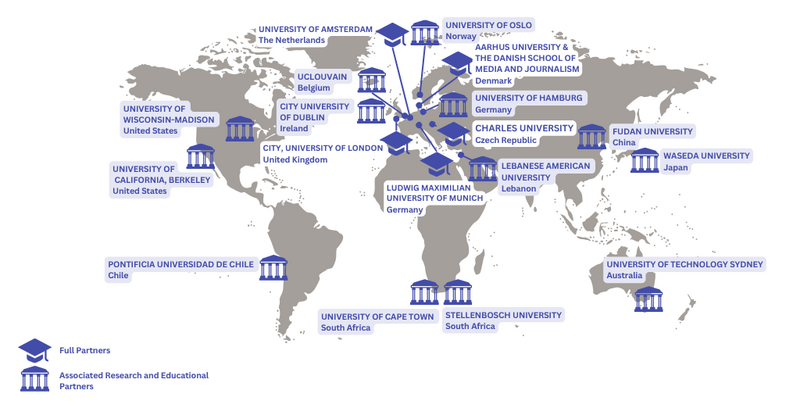
The Erasmus Mundus Journalism master's degree offers you a truly unique and international educational experience. You will study at leading universities in at least two European countries. Selected students can add a third country by studying at one of our prestigious, credit awarding, universities, in the second semester.
Your second year of studies will give you a distinctive academic and journalistic profile within ‘Authoritarianism & Transition’; ‘Crisis & Conflict’; ‘Politics & Communication’; or ‘Cultures & Contexts’.
First year, you will be studying in Aarhus, Denmark
All students spend the first year of the master’s degree in Aarhus, Denmark studying at both Aarhus University and the Danish School of Media and Journalism.
You can customise your studies by choosing to take electives or an internship (10 ECTS) as part of your second semester. Or you can apply to be one of the selected students who can study their second semester (30 ECTS) at one of our prestigious credit awarding universities.The aim of the first year is to give you the analytical skills needed to identify and analyse cultural, political, and technological challenges to and opportunities for journalism across the globe. You will also learn how to integrate this theoretical understanding with practical approaches, to assert journalism within a changing public sphere.
As the EU mandates that students participating in Erasmus Mundus programmes undertake their studies in a minimum of two different countries, neither of which should be their country of residence, Danish students (and students with permanent residency in Denmark) must pursue the second semester of their first year of studies at one of our Study Abroad partner universities.
In the year 2, you will be studying in either Amsterdam, London, Prague or Munich
In the second year, you will be able to specialise in the area of your choice to delve into field-specific topics.
- Politics & Communication at the University of Amsterdam, the Netherlands
- Authoritarianism & Transition at Charles University in Prague, the Czech Republic
- Crisis & Conflict at City St George’s, University of London, the United Kingdom
- Cultures & Contexts at Ludwig-Maximilians-Universität München, Germany
Please note that during the application process, you will be asked to select your year 2 specialisation. The year 2 specialisation cannot be changed.
As the EU mandates that students participating in Erasmus Mundus programmes undertake their studies in a minimum of two different countries, neither of which should be their country of residence, students with a permanent residency in the Netherlands, the Czech Republic, Germany, or the UK must opt for a year 2 specialisation in a country other than their country of permanent residence.
Selected students can spend their second semester at one of these prestigious, credit-awarding universities:
- Austria: University of Vienna
- Belgium: Université Catholique de Louvain
- Chile: Pontificia Universidad Católica de Chile
- China: Fudan University
- Germany: University of Hamburg
- Ireland: City University of Dublin
- Japan: Waseda University
- Norway: University of Oslo
- Switzerland: University of Zurich
USA: University of Wisconsin-Madison
The list of universities is indicative only. The available partner universities for each intake can only be confirmed after the start of the programme, as they depend on the specific exchange agreements in place for that academic year.
Danish students - and students with permanent residency in Denmark 🇩🇰
As the EU requires that Erasmus Mundus students study in at least two different countries— Danish students (and students with permanent residency in Denmark) complete their first semester in Denmark but must spend the second semester at one of our Study Abroad partner universities. This ensures that they meet the mobility requirement of studying in two different countries in addition to their country of permanent residence.
Danish students must be eligible for SU for the entire duration of the programme (that is, you must have sufficient SU eligibility remaining to cover the full Mundus degree).
SU eligibility is required in order to apply for the Danish Study Abroad Grant (Udlandsstipendium), which is used to cover the second-year tuition fee. Under Danish legislation, Danish students are not permitted to pay tuition fees for a Danish university degree themselves.
Students with permanent residency in Germany 🇩🇪; the Netherlands 🇳🇱; the Czech Republic 🇨🇿; and United Kingdom 🇬🇧
As the EU mandates that students participating in Erasmus Mundus programmes undertake their studies in a minimum of two different countries, neither of which should be their country of residence, students with a permanent residency in the Netherlands, the Czech Republic, Germany, or the UK must opt for a second-year specialisation in a country other than their country of permanent residence.